

a leader with presence leads a meeting with the help of AI
An AI-generated workplace scene. 😉

Presence in the Age of AI

AI can analyze conversations and reveal participation patterns. But leaders still need presence to interpret context, trust, power, and risk — and to turn shared contribution into better decisions.

“I could feel that it wasn’t okay.”

That is how a leader described a meeting where, on paper, everything seemed ready. AI had helped her analyse previous discussions, compare scenarios, map risks, and prepare a clear briefing. It had even highlighted interaction patterns: who had spoken most, where disagreement had appeared, which themes kept returning, and which voices had become less present.

The analysis was useful. More than useful. It made visible dynamics that are easy to miss in real time.

And yet, as the conversation unfolded, she felt discomfort growing. People were agreeing, but quickly. A usually direct colleague became careful. The person closest to implementation asked one question, then went quiet. Nothing was openly wrong. The meeting was smooth, but not fully alive.

Her first impulse was to move on. The agenda was full, the decision was needed, and the preparation had been thorough. But she noticed the difference between apparent agreement and real commitment. The issue was not whether the analysis was correct. It was whether the decision would actually hold once people had to act on it.

So she paused and asked:

“What are we not saying yet?”

And she waited.

When the Room Knows More Than the Data

A colleague explained that, in one local team, the proposed change echoed an earlier restructuring that had left people feeling ignored and exposed. It was not in the data pack. It was not in the AI analysis. It lived in the team’s memory.

Suddenly, the hesitation made sense. The decision did not fall apart. It became more honest.

That moment captures something essential about leadership in the age of AI. AI can make interaction dynamics visible. Presence enables leaders to interpret what the data cannot explain on its own.

AI can analyze speaking time, interruptions, recurring themes, sentiment, divergence, and participation patterns. Inclusive leadership can be invaluable. Used well, this data can improve the conditions for participation and execution. It gives leaders a clearer view of how the conversation is structured, where contribution is uneven, and where risks may be softened before they disappear from the official summary.

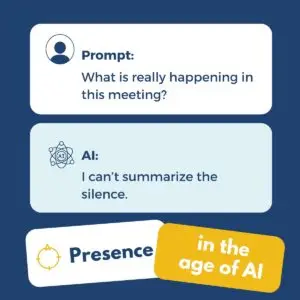
But interaction data is never just data. It shows patterns; it does not automatically explain their meaning. It carries context, history, trust, power, risk, and psychological safety. A silence is not just a silence. It may be agreement, fatigue, caution, cultural restraint, fear of consequences, strategic withdrawal, or the quiet calculation that speaking up is not worth the cost.

Prompt and AI answer

Presence Strengthens Discernment

For many senior leaders, presence can sound suspiciously soft. When the pace is high and decisions must be made with incomplete information, presence may sound like a luxury.

It is not.

In times of uncertainty, leaders are rarely short of information. They are often surrounded by too much of it: dashboards, forecasts, scenarios, stakeholder opinions, alerts, and AI-generated outputs arriving faster than teams can always absorb.

The leadership challenge is not only to access more intelligence. It is to stay clear enough to make sense of it.

Presence is the capacity to remain grounded while complexity accelerates. It creates enough internal space to pause before reacting to the loudest signal, the most urgent request, or the most polished analysis. It allows leaders to notice whether a decision is merely understood or genuinely ready to be carried out.

This matters because speed without commitment often creates delays elsewhere: private conversations, passive resistance, unclear ownership, repeated clarification, or decisions that are reopened later. Presence supports execution by improving the quality of commitment before the decision leaves the room.

How Coaching Develops Presence

Coaching supports leaders in developing presence because it creates a space where they can examine not only the situation, but their own way of entering it.

What happens under pressure? Do they rush to clarify, decide, convince, smooth over, control, or avoid? What signals do they notice easily, and which ones do they tend to miss?

This is not about giving leaders more advice. They usually have enough advice. It is about strengthening the capacity to use data without becoming blinded by it: to notice, interpret, discern, and choose.

A coaching conversation can bring a leader back to questions that are simple, but not always easy:

What needs my attention here?
What am I not saying?
What is the group not saying?
Where am I confusing agreement with commitment?
What made contribution easier for some — and riskier for others?

AI can analyze the conversation. Presence reveals what is really at stake.

Share :

Other posts

Power dynamics in workplace - connection

Power Dynamics in Intercultural Workplaces

In intercultural environments, power dynamics aren’t always visible—but they strongly shape who gets heard, supported, or sidelined. This post invites you to strengthen your inclusive leadership through three key levers: Presence, Courage, and Connection.

Read the post